
The canals linking the Atlantic and the Mediterranean Seas
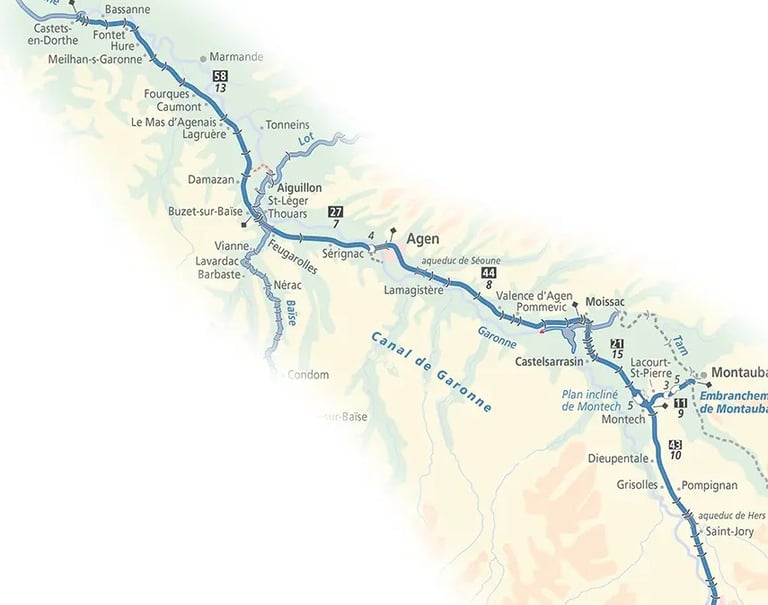
The Canal de Garonne (Deux Mers Canal) joins the river Garonne at Castets en Dorthe then continues South until it becomes the Canal du Midi at Toulouse.
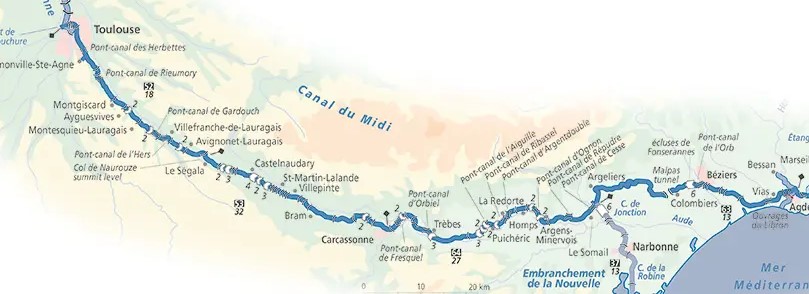
The Canal du Midi from Toulouse to Adge. The two navigable canals join together linking the Atlantic and the Mediterranean Sea.
Centuries ago, “tariff” was a levy paid to Spain by ships using the Strait of Gibraltar; it was named for Tarifa, the town near the strait’s narrowest point. France’s kings had long dreamed of a waterway linking the Atlantic to the Mediterranean: as well as depriving the Spanish monarch of easy money, it would save ships a long voyage around Spain and Portugal, risking storms and pirates.
From the Atlantic, vessels can reach Toulouse from the Gironde estuary (on the Garonne River), but not until the 1660s did anyone have a viable plan for the remaining 200km to the Med. Considered one of the biggest engineering feats of the 17th century, Pierre-Paul Riquet’s Canal du Midi (finished in 1681 and called the Canal Royal du Languedoc until the revolution) rewrote the history of transport and commerce in the south of France – for centuries it carried wheat and wine, people and post.
In 1996, Unesco added the canal to its world heritage list, citing the way Riquet “turned a technical achievement into a work of art”. Today, the canal attracts more than 70,000 visitors a year, almost three-quarters of them from outside France. From La Ville Rose (as Toulouse is known) to the sea, here is how to enjoy it, however you decide to travel.
Toulouse-Carcassonne
The canal south-east of Carcassonne sees the most tourists; the Toulouse side has fewer attractions, but is enjoyably quieter, all sunflower fields and old windmills. In centuries past, horse-drawn barges would make their first stop at Négra lock; it’s a good place to clock the unusual oval shape of the lock basins, which helps the stone walls withstand water pressure.
The technically minded will enjoy the Seuil de Naurouze, the canal’s highest point, where it crosses the watershed between the Atlantic and the Med. Key to Riquet’s plan was feeding the canal with water channelled from the Montagne Noire, north-east of here. It’s a peaceful spot, with an avenue of plane trees leading to an obelisk commemorating the engineer.
Eight miles on is Castelnaudary, home of rib-sticking bean cassoulet, invented while the town was besieged by the English in 1355: The coming of the canal boosted this town’s fortunes: waterside terraces on its lake-like Grand Bassin have an expansive feel, and a 10-minute climb to the restored 17th-century Cugarel windmill offers great views.
Carcassonne – and on
Much has been written about Carcassonne’s medieval citadel, but it is best avoided in the summer season. The canal grows more attractive from here though, even if the towpath gets bumpier. Sleepy villages in golden stone include Trèbes, between the canal and the Aude River, with its 13th-century church, marina and Sunday market. A lovely walk south-east takes in the Domani des Peres, an olive oil mill, and a three-lock flight on which boats drop seven metres of their 80-metre descent to the Mediterranean.
Paraza, 25 miles on, is an arty village, home to several studios and the CLAP Gallery (Centre Local d’Art Parazanais). The Chateau winery offers tastings. The Chateau de Paraza winery offers tastings.
Toulouse is just under 200km from the sea, but the canal’s many loops and meanders add another 40km. One loop, just after Paraza, runs to France’seanders add another 40km. One loop, just after Paraza, runs to France’s first canal aqueduct, the 1676 Pont-Canal de Répudre, the parapets of its one-arch bridge spanning the river of the same name.
Escape the canal
There’s a holiday feel to the route after Capestang. The countryside is more open, there are more pleasure craft on the water, and plenty of attractions.
It’s worth detouring a few miles to the village of Saint-Chinian, in Languedoc’s oldest winemaking area. It has narrow streets, shady squares and a Benedictine abbey, but also lots of ways to get active. Rock climbers can tackle any of 15 routes up the magnificent west-facing Notre-Dame cliff nearby. You will find kayaking on the Vernazobre and Orb rivers, horse riding and cycling among the vines on Oenovelo 1, a mostly off-road bike route that links Saint-Chinian to the canal at Colombiers. This makes a nice change if you have been riding the towpath for days.
South of here is the circular, spiral-built village of Puisserquier topped by its 1,000-year-old battlemented castle. Then it’s back to the canal at Capestang, with its chunky stone bridge and great market (Wed and Sun) by the tall Saint-Étienne church.
To Béziers and the coast
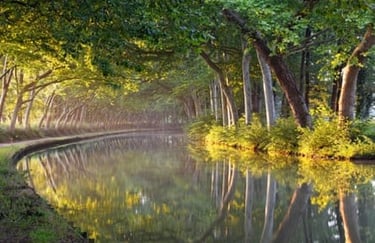
The area around the ancient village of Colombiers used to be classic Insta-worthy Canal du Midi – curved stretches of waterway reflecting rows of tall planes – but severe canker stain infection saw about 1,600 trees felled. Many have been replanted, though, and are now thriving. Before Colombiers, there are two sites of note. The Oppidum d'Enserune is a Gallic hill fort dating from the sixth century BC. A scenic walk away is the world’s oldest canal tunnel, the Malpas, bored through a ridge. Finished in 1680, it takes just a few minutes to pass through but is a unique experience for boats, bikes and walkers.
Colombiers is the place to take to the water if you haven’t already. There are rowing boats, kayaks and paddleboards to hire – and guided sightseeing trips. Colombiers’ 12th-century chateau is mostly closed for restoration, but there are guided tours on Wednesdays. Check out the wine cellars, glazed in multicoloured metro tiles.
Just outside Béziers is maybe the canal’s most remarkable sight: the “nine locks” of Fonseranes, allowing boats to drop 21 metres. It’s a lively spot, with plenty of spectators on the banks. Boats now enter and leave via basin seven, so the flight is six locks, but it’s impressive all the same.
The canal empties into the Etang de Thau at Les Onglous, but boats would then cross the lagoon to unload at Sète harbour, which Riquet also designed. Sète is a pretty, lively port town, with train links on to Marseille and Avignon or back to Toulouse. It has canals of its own, sandy beaches, a covered market and traditional water jousting tournaments (great fun to watch)
Events on the Canal
Les Escales du Canal, the 1st weekend in July.
A new summer event that takes place the 1st weekend. Local authorities along the Canal du Midi are invited to organise a community-based gourmet event to bring locals and tourists together around the Canal du Midi. Refreshments are available, as well as food trucks and various sorts of entertainment to make this event as enjoyable as possible, including concerts, farmer's markets, street performances, exhibitions on the theme of the Canal du Midi.
CanalissimÔ Festival June-July
The CanalissimÔ festival at Portiragnes has become an unmissable event on the Canal du Midi. It takes place at Portiragnes lock on the banks of the Canal du Midi and there is an action-packed programme of entertainment. The event was created in 2009 and now includes a dozen shows each year.
Convivencia Festival in July
"From Toulouse to Montpellier, a barge transformed into a travelling stage offers musical performances along the Canal du Midi. [...] Locals, tourists and families gather on the banks in a traditional 'guinguette' atmosphere to enjoy food and drink together. Current world music artists perform on the deck of the barge, with a different line-up for each stop. This is a local festival, designed with the local residents, for the local residents and for people passing through to come and discover or rediscover the famous 'Canal du Midi', a listed UNESCO World Heritage Site."
The annual Convivencia festival stops at around fifteen different places along the canal route. It was created in 1997 and really embraces the Canal du Midi as a means of bringing people together and to develop the regions, from Toulouse to the Mediterranean Sea.
In the run-up to this travelling festival, there are also opportunities to learn about the canal heritage, in the spring preceding this summer event. These moments of discovery are known as 'Canal Insolite' and are organised in partnership with VNF and the Occitanie region, to introduce some of the canal's little-known structures such as the dry docks or the heritage sites alongside the canal such as the Château de Ventenac (Ventenac-en-Minervois, Aude).
The Rallye du Canal du Midi rowing event in August
Departing from Port-Lauragais to Béziers, August 2023 marked the 40th edition of the Rallye du Canal du Midi rowing event. The Association Toulouse Pierre-Paul Riquet (ATPPR) has been organising this rowing event on the Canal du Midi since the 1980s. Classified as a 'Randon’aviron' event by the FFA (French rowing federation), this event involves teams of 4 rowers and 1 helmsman in a yolette rowing boat and 2 cyclists to take over in turns and provide technical assistance (embarking and disembarking, etc.). The route passes through several locks where participants will need to moor their boats, using adapted chariots that are transported on each yolette.
Since 2022, there has been another event organised alongside this one, known as Enduro Canal, which is a timed long-distance race in a skiff (not hired) or a yolette. Each boat is accompanied by a cyclist so that participants can take it in turns and also get any required technical assistance. Yolettes are equipped with a chariot to pass the locks. This race is suitable for experienced rowers!
Canalathlon in October every 2 years
The 'Canalathlon' is a 35 km fun sporting event that combines MTB, running, cycling and canoeing both on and alongside the canal. This event has been organised since 2017 by the PETR (Territorial and Rural Balance Cluster) of the Pays du Lauragais as part of the European LEADER (Links Between Actions for the Development of the Rural Economy) programme, and is just as much a tourism initiative to discover the landscapes of the Lauragais and the local products, as an awareness campaign for responsible, sustainable use of the canal, with events on the theme of energy, and a part of the registration fees goes to VNF for replanting the canal banks.
Your Guide to the Route